
Tranexamic Acid for Heavy Periods: The Non-Hormonal Option Nobody Told You About
Tranexamic acid cuts heavy period bleeding by roughly half, contains no hormones, and you only take it on the days you bleed. Here is how it works, who it suits, what it costs, and exactly what to ask your provider for.
It cuts bleeding by roughly half, has no hormones in it at all, and you only take it on the days you actually bleed.
Tranexamic acid is the best-supported non-hormonal treatment there is for heavy periods, and most people who would benefit from it have never had it mentioned to them. Here is what it does, who it suits, and what to say at your appointment.
The quick answer
Tranexamic acid is a prescription tablet that stops the clots in your uterine lining from dissolving too quickly, which is what drives the flooding, the clots, and the change-every-hour days. It reduces menstrual blood loss by around 40 to 50 per cent on average. It has no hormones in it, it does not change your cycle length or your fertility, and you take it only on your heaviest days, usually three to five days per period.
The catch: it needs a prescription in the US and Canada, it is not right for you if you have a history of blood clots, and it treats the bleeding rather than whatever is causing it.
What counts as a heavy period
A lot of people spend years assuming their period is normal because it is the only period they have ever had. So before anything else, here is the practical version of the clinical definition.
Your period counts as heavy if any of this sounds familiar:
- You soak through a regular pad or tampon in an hour or less, more than once
- You double up — a tampon and a pad together — as a matter of routine
- You get up in the night to change
- You pass clots bigger than a quarter or a loonie
- Bleeding regularly runs past seven days
- You have built your schedule around it: skipped class or practice, sat on a towel, kept spare trousers in your bag, bled through onto a chair
The clinical threshold is more than 80 mL of blood loss per cycle, which is roughly five or six soaked regular tampons a day for the first couple of days. Nobody measures this in real life and you should not have to. Impact on your life is a legitimate reason to seek treatment, full stop.
Heavy menstrual bleeding, sometimes still called menorrhagia in older material, affects somewhere between a quarter and a third of people who menstruate at some point. It is common. It is also very treatable, which is the part that gets lost. If you are not sure where yours sits, our when to seek care guide walks through it symptom by symptom, or you can ask Sarah, the Periodwise assistant, without booking anything.
What tranexamic acid actually is
Tranexamic acid is a synthetic medication in a class called antifibrinolytics. The word looks intimidating and means something simple: anti (against), fibrino (fibrin, the protein mesh holding a clot together), lytic (breaking down). It works against the breakdown of clots.
You may have seen the name somewhere unexpected. Tranexamic acid also turns up in skincare, in serums aimed at melasma and dark spots, at far lower concentrations and applied to your face. Same molecule, entirely different product. Topical tranexamic acid does nothing whatsoever for your period, and this is one of the most common confusions about the drug.
In the US it is sold as Lysteda, and as generic tranexamic acid tablets, which are usually much cheaper. In Canada and the UK the common brand name is Cyklokapron. It has been used for heavy periods in Scandinavia and the UK since the 1960s and it sits on the World Health Organization list of essential medicines. It only received FDA approval specifically for heavy menstrual bleeding in 2009, which is late for a drug that old, and part of why so few people in North America have heard of it.
How it works, in plain language
Your uterine lining does not simply bleed. It bleeds, clots, and then deliberately dissolves those clots so the tissue can shed and leave. That dissolving process is called fibrinolysis, and it is supposed to happen.
In a lot of people with heavy periods it happens too enthusiastically. The lining produces more of the enzymes that break clots down, so clots dissolve before they have done their job of slowing the flow. The result is more blood, faster, and often the large gel-like clots that get pushed out when bleeding outpaces the dissolving process entirely.
Tranexamic acid blocks the enzyme responsible from binding to the clot. The clots hold. The bleeding slows. That is the whole mechanism.
Two things follow from that. It works locally on the process of bleeding rather than on your hormones, so it does not touch your cycle, your ovulation, your mood, or your fertility. And because it works on clots specifically, it is genuinely powerful for flooding and clot-heavy periods while doing comparatively little for the other symptoms that travel with them.
How well does it work?
This is the part that makes it worth the appointment. Across randomised trials, tranexamic acid reduces measured menstrual blood loss by roughly 40 to 50 per cent on average, with individual results ranging from about a quarter to well over half. It consistently outperforms both anti-inflammatory painkillers and progestogen tablets taken in the second half of the cycle for this specific purpose.
In practice, people describe it less in percentages and more like this: day two stops being an emergency. The clots get smaller or disappear. You change your product on a normal schedule instead of watching the clock. You stop needing to know where every bathroom in the building is.
It does not usually turn a heavy period into a light one. It turns an unmanageable period into a manageable one, which is a different goal and often a sufficient one.
How to take it, and how fast it works
This is the genuinely convenient bit. You do not take tranexamic acid every day. You take it only while you are actively bleeding heavily, then you stop until next month.
The typical prescribed regimen in the US is 1300 mg — two 650 mg tablets — three times a day, for a maximum of five days during your period. In Canada and the UK, prescribing more often looks like 1 g three or four times a day for up to four days. Your prescriber will tell you which applies to you, and their instructions override anything on this page.
A few practical notes that the pharmacy printout leaves out:
Start when the bleeding starts, not before. Unlike ibuprofen or naproxen, which many people begin a day early to get ahead of cramps, tranexamic acid has nothing to act on until there is bleeding to slow. Take the first dose when your flow actually begins in earnest.
You do not have to use all five days. Plenty of people take it for the two or three heaviest days and stop. There is no benefit to pushing through days when your flow is already light.
Set alarms. Three times a day sounds easy and is not, particularly on day one when you feel awful. The doses are spaced through the day for a reason, and a skipped middle dose is the single most common reason people conclude it did not work.
Swallow the tablets whole with a full glass of water. Do not crush or chew them. With or without food is fine, though food helps if they make you queasy.
Tell your prescriber about any kidney problems. Reduced kidney function means the dose has to be adjusted down.
Most people can tell during the first period they use it on, often within a day. The standard clinical advice is still to give it two or three cycles before deciding, because periods vary month to month on their own and one unusually heavy or unusually light cycle is not a verdict.
If you have used it properly for three cycles and your flow is not meaningfully better, that is real information. Go back to your provider rather than dropping it without saying so. It usually means the underlying cause needs a closer look, or that a different or additional treatment would suit you better.
How to get it in the US and Canada
In both the US and Canada, oral tranexamic acid for heavy periods is prescription only. You cannot pick it up off a shelf.
There is a common point of confusion here, because in the UK a lower-dose version is available directly from pharmacists without a prescription, and in Sweden it has been available over the counter for decades. Neither applies to you in North America, and buying prescription medication from overseas websites is not a shortcut worth taking.
The good news is that this is a straightforward prescription to obtain. It is not a controlled substance, the conversation is short, and generic tranexamic acid is inexpensive — often far cheaper than branded Lysteda, so ask specifically for the generic. If cost is a concern, prescription discount cards frequently bring it down further.
A family doctor, a gynecologist, a campus health service, or a telehealth appointment can all prescribe it. Telehealth suits this well, because the assessment is mostly a conversation about your bleeding pattern and your medical history, and it skips the wait for a gynecology referral. Some presentations do warrant an in-person exam, so expect to be sent for one if your history calls for it. Our guide to preparing for an appointment covers what to bring either way.
Side effects, honestly
Most people tolerate tranexamic acid well, which is unsurprising given how short the courses are. Roughly a third experience something from this list, more often at higher doses, and most of it is mild and stops when the tablets do:
- Headache and migraine
- Nasal and sinus congestion
- Back pain, abdominal pain, and muscle cramps or spasms
- Joint and muscle aches
- Fatigue
- Nausea
The rare but serious ones are worth knowing so you can recognise them.
Blood clots. Because the drug’s entire purpose is to stabilise clots, there is a small increase in the risk of one forming somewhere you do not want it. In the trials, rates were not meaningfully higher than placebo among people without clotting risk factors, which is exactly why the medical history conversation matters. Signs to act on: swelling, pain, warmth, or redness in one leg, usually the calf; sudden shortness of breath; chest pain; coughing up blood; a sudden severe headache; weakness or numbness on one side of your body; or trouble speaking. Any of those means emergency care, not wait and see.
Changes to your colour vision. Uncommon, and mostly associated with longer or higher-dose use. If colours look different, or your vision changes at all while you are taking it, stop and contact your provider.
Allergic reaction. Hives, difficulty breathing, or swelling of the face, lips, tongue, or throat means emergency care.
Who should not take it
Tranexamic acid is not suitable if you have or have had:
- A blood clot — a deep vein thrombosis, a pulmonary embolism, a stroke, or a retinal vein or artery occlusion
- An active clotting condition of any kind
- An inherited clotting disorder such as factor V Leiden
- A subarachnoid hemorrhage
- Acquired defective colour vision
- A known allergy to tranexamic acid
It also needs caution and possibly a lower dose with reduced kidney function, and a careful conversation if you have a strong family history of clots, if you smoke, if you get migraine with aura, or if you take anticoagulants.
None of that is a reason not to bring it up. It is a reason to be thorough about your history at the appointment.
The birth control interaction that matters most
This one gets its own section, because a large share of the people reading this are on the combined pill and it is the interaction most likely to be relevant to you.
The combined pill, the patch, and the ring all carry their own small increase in clot risk from the estrogen in them. Tranexamic acid stabilises clots. Put together, the risks compound — and the US label for Lysteda goes as far as listing current use of combination hormonal contraception as a contraindication.
In practice, providers either avoid the combination, switch you to a method without estrogen, or in some cases accept it after a proper discussion with someone who has no other risk factors. That is a decision for your prescriber to make deliberately, not something to stack on your own.
So tell your prescriber exactly what contraception you are on. Including the ring. Including the patch. Including the one you have been on so long you forgot it counts. This is the single most important thing to volunteer at that appointment.
Progestogen-only methods — the mini-pill, the implant, the injection, and the hormonal IUD — do not carry the same estrogen-related clot risk, and are a different conversation.
How it compares to the other options
Tranexamic acid is one of several evidence-based treatments for heavy bleeding, and it is not automatically the best one for you. The honest comparison:
Option | Cuts blood loss by | Hormonal | When you take it |
|---|---|---|---|
Tranexamic acid | 40 to 50% | No | Bleeding days only |
Anti-inflammatory painkillers | 20 to 40% | No | Period days |
Combined pill | 35 to 50% | Yes | Every day |
Hormonal IUD | 70 to 90% | Local only | Once, lasts 5 to 8 years |
What the table cannot show is what each one does beyond the bleeding, which is often what decides it. Anti-inflammatory painkillers — naproxen, ibuprofen, mefenamic acid — lower the prostaglandins that drive both the bleeding and the cramping, so they are the only option on that list that treats pain properly. The combined pill also helps with cramps, acne, and predictability, and is contraception. The hormonal IUD is contraception, usually reduces cramps, and often stops periods altogether. Tranexamic acid works on the flow and only the flow.
Three other things fall out of that table.
The hormonal IUD — the 52 mg levonorgestrel kind, meaning Mirena or Liletta rather than the smaller-dose versions — is the most effective single treatment for heavy bleeding by a wide margin, and most clinical guidelines put it first when contraception is also wanted or acceptable. If nobody has offered you one, ask why. If the insertion is what is putting you off, we have written honestly about what it is actually like.
Tranexamic acid is the strongest non-hormonal option, which makes it the obvious choice if you do not want hormones, cannot take them, are trying to conceive, or simply want to keep your own cycle intact while making the bleeding survivable.
Tranexamic acid and anti-inflammatory painkillers are often used together, because they work on completely different mechanisms and cover different symptoms — the tranexamic acid handles the flow, the naproxen or ibuprofen handles the cramps. Confirm it with your provider rather than assuming, particularly with any stomach or kidney issues. Our relief and options guide lays out what each treatment actually does.
What it does not do
Setting expectations properly here saves a lot of disappointment.
It is not contraception. It does not prevent pregnancy in any way. If you need contraception, you still need contraception.
It does not do much for cramps. Some people find cramps ease a little because there is less volume to pass, but it is not a painkiller and it has no anti-inflammatory action. Pair it with naproxen, ibuprofen, or whatever already works for you.
It does not regulate your cycle. If your problem is unpredictable timing, skipped periods, or bleeding between periods, this is not the tool. Those patterns point at something hormonal and need a different assessment.
It does not treat the cause. This is the important one. It manages the symptom brilliantly while doing nothing about the fibroid, adenomyosis, polyp, thyroid problem, or bleeding disorder that may be behind it. Symptom control and investigation should run in parallel, not instead of one another.
The iron conversation nobody starts early enough
Heavy periods are the most common cause of iron deficiency in people who menstruate, and the deficiency arrives long before anemia does. You can have a perfectly normal hemoglobin, completely empty iron stores, and feel awful.
Iron deficiency without anemia looks like exhaustion that sleep does not fix, breathlessness on stairs you used to manage fine, brain fog, hair shedding, cold hands and feet, restless legs at night, and sometimes a strange craving to chew ice. If you train, it looks like your performance falling off a cliff for no reason you can name.
The test that matters is ferritin, which measures your stored iron. A standard complete blood count will not tell you this and will look normal until things are fairly advanced. You have to ask for ferritin specifically, and plenty of providers will not order it unless you do.
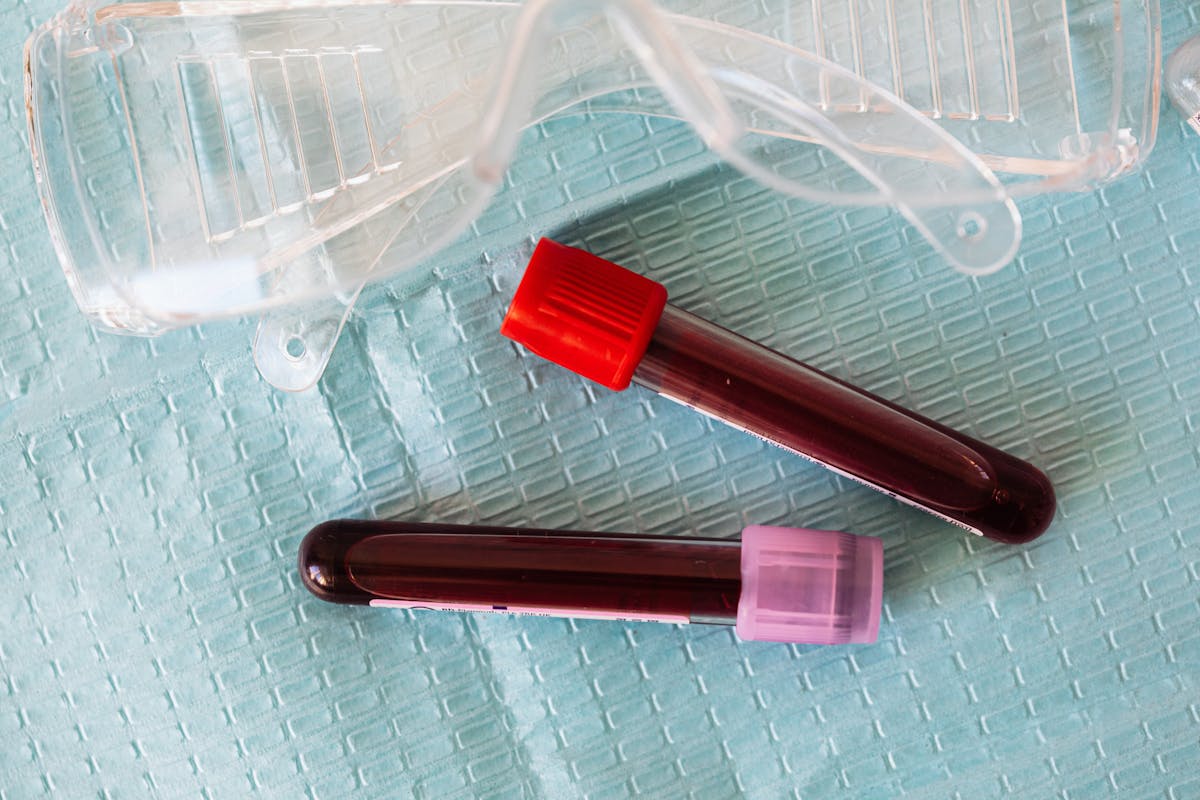
Going through your doctor is the better route if you can, because you want the bleeding looked at as well as the iron. The at-home option is there for when the appointment is the bottleneck, and it is US only.
If your ferritin comes back low, supplementing is straightforward, though absorption is fussy. Every other day tends to beat every day, vitamin C helps, and calcium, coffee, and tea within a couple of hours of the dose block it.
Do not skip straight to supplementing, though — test first. There is a fuller version of all of this in our guide to period fatigue.
What might be causing the heavy bleeding
Tranexamic acid buys you a manageable period. It does not answer the question of why. Worth pursuing in parallel:
A bleeding disorder. The one most often missed, and it matters enormously if you are young — up to one in five adolescents with heavy periods has an underlying bleeding disorder, most commonly von Willebrand disease. The clue is that your periods have been heavy from the very first one rather than becoming heavy later. Other clues: you bruise easily, you get frequent nosebleeds, you bled a lot after dental work or surgery, or a relative has a similar history. If that is you, say so explicitly, because it changes the entire workup.
Fibroids. Benign growths in or on the uterine wall. Very common, often symptomless, but capable of causing heavy bleeding and pressure symptoms depending on where they sit.
Adenomyosis. Endometrial tissue growing into the muscular wall of the uterus. Classically heavy bleeding plus significant pain, and historically underdiagnosed.
Polyps. Small growths in the uterine lining or cervix, usually benign, often causing heavy or irregular bleeding.
Thyroid dysfunction. An underactive thyroid in particular can make periods heavier, and it is checked with a simple blood test.
Cycles without ovulation. Common in the first few years after your first period and again approaching menopause, and a feature of PCOS. Without ovulation you do not get the progesterone that keeps the lining in check, so it builds up and sheds unpredictably and heavily.
Our guide to the conditions behind heavy periods goes through each of these properly, including what the diagnosis process actually involves. Bleeding between periods, bleeding after sex, or any bleeding after menopause needs assessment rather than management.
What to say at your appointment
Providers respond to specifics. A vague report of heavy periods gets a vague response, because nobody knows whether you mean inconvenient or dangerous. Bring numbers.
For two cycles beforehand, note down:
- How many pads or tampons you use each day, and what absorbency
- How often you double up
- Whether you bled through anything, and where you were
- How many nights you got up to change
- The size of the largest clots
- How many days you bled
- Anything you missed or cancelled because of it
Then say something close to this:
"My periods are heavy enough that they are affecting my life. On my heaviest days I go through a super tampon every hour or two and I have bled through in public. I am passing clots bigger than a quarter. I would like to talk about treatment options, including tranexamic acid, and I would also like my ferritin checked and to talk about whether a bleeding disorder should be ruled out, because my periods have been like this since they started."
Adapt it so it is true for you. The reason to name tranexamic acid out loud is that it is genuinely under-offered in North America, and naming a specific option tends to move the conversation from reassurance to problem-solving.
Also tell them:
- Every medication and supplement you take
- Your exact contraception, including the patch or ring
- Any personal or family history of blood clots
- Any kidney problems
- Whether you smoke
- Whether you get migraine with aura
When to get help urgently
Do not wait for a scheduled appointment if you are:
- Soaking through a pad or tampon every hour for two hours or more in a row
- Feeling faint, dizzy, or short of breath, or your heart is racing
- Passing clots larger than a golf ball
- Bleeding heavily with any chance you are pregnant
- Going very pale, or feeling like you might pass out when you stand
That is emergency department territory, not a phone-call-on-Monday situation.
Frequently asked questions
Does tranexamic acid stop your period?
No. It reduces how much you bleed, typically by around 40 to 50 per cent, but you will still have a period and it will last roughly as long. It is a volume reducer, not a period suppressant. If you want to skip or stop periods, that is a hormonal conversation, usually about continuous use of the combined pill or a hormonal IUD.
How long does tranexamic acid take to work?
Most people notice a difference during the first period they use it on, often within the first day. Clinically you are advised to assess over two to three cycles before deciding whether it is working, since periods vary naturally month to month.
Can you buy tranexamic acid over the counter?
Not in the US or Canada, where oral tranexamic acid for heavy periods is prescription only. It is available directly from pharmacists in the UK and over the counter in Sweden, which is where the confusion comes from. Getting a prescription is usually simple and can be done by telehealth.
Can you take tranexamic acid with the pill?
Only with your prescriber’s specific approval. The combined pill, patch, and ring contain estrogen, which carries its own small clot risk, and tranexamic acid stabilises clots. The US label for Lysteda lists current use of combination hormonal contraception as a contraindication, so this is a deliberate decision your prescriber has to make, not something to combine on your own. Tell them exactly what contraception you use. Progestogen-only methods do not carry the same estrogen-related concern.
Does tranexamic acid help with cramps?
Not directly. It has no pain-relieving or anti-inflammatory action. Some people find cramps ease slightly because there is less blood and fewer clots to pass, but if cramps are a main problem you want an anti-inflammatory painkiller such as naproxen or mefenamic acid, which lower the prostaglandins driving the pain. The two are often used together.
Can you take tranexamic acid every month, long term?
Yes. It is designed for repeated cyclical use and has been used that way for decades. Because you only take it for a few days per cycle, total exposure stays low. Your provider should still review it periodically, particularly if anything changes in your health or your contraception.
Does tranexamic acid affect fertility?
No. It contains no hormones, does not affect ovulation, and does not act as contraception. That is one reason it is often chosen by people who are trying to conceive but struggling with heavy periods. Do tell your provider if you are pregnant or trying.
Is it the same as the tranexamic acid in my skincare?
Same molecule, entirely different product. Topical tranexamic acid serums target melasma and pigmentation at low concentrations on the skin and have no effect on menstrual bleeding whatsoever. Do not attempt to substitute one for the other in either direction.
Can teenagers take tranexamic acid?
Yes. It is approved from age 12 onwards once periods have started, and it is used routinely in adolescent gynecology, including as a first-line option for teenagers with heavy periods who do not want or need hormonal treatment. If you are under 18, this is a conversation to have with a provider and a parent or guardian involved.
Does it make period clots worse?
This is a reasonable worry given how the drug works, and the answer is no. It stabilises the microscopic clotting at the level of the uterine lining, which slows the bleeding overall. Most people report smaller and fewer visible clots on it, not more, because clot size largely reflects blood pooling faster than it can leave.
What if tranexamic acid does not work for me?
If three properly-taken cycles have not helped meaningfully, go back and say so. It may mean the dose needs adjusting, it may mean a combination approach suits you better, or it may mean the underlying cause needs investigating more seriously. Failure to respond is itself useful clinical information, so it is worth reporting rather than dropping.
Where to go from here
If you are weighing this against the other options, our period pain and relief plan takes a few minutes and matches treatments to your actual pattern, including whether it is time to book. You can also ask Sarah, the Periodwise assistant, anything you would rather not say out loud yet.
Related reading:
Know someone who should read this?
Most of us learn this from a friend, not a doctor.